


Iran. Again and again.
Ever since Ahura Mazda the region just keeps popping up on the global stage!
Iran. A land where history runs as deep as the rivers that carve its ancient valleys. From the divine proclamations of Ahura Mazda to the empires of Assyria and Persia, the Persian Corridor—this storied passage linking the Persian Gulf to the Caspian Sea—has been a crucible of human ambition for millennia. Here, Zoroastrianism’s sacred flames mingled with Islamic rituals to birth Shia Islam’s unique traditions, while trade routes and conquests wove a tapestry of cultural exchange. The Corridor’s strategic allure, undimmed by time, has drawn the gaze of global powers across centuries, from Alexander’s armies to modern superpowers. In the 20th century, Britain and the United States stepped onto this stage, their involvement fueled by oil, war, and the enduring chessboard of geopolitics. To understand their impact—and why Iran remains a flashpoint today—we turn to the pivotal Anglo-American chapter in this ancient land’s saga, beginning with a little-known but decisive operation in World War II.
Geostrategic hotspots don’t change. We forget them at our peril.
The post WWII to recent modern geopolitical analysis we will reserve for the Members Only and Coffee Club registrants, as it begins to delve into topics that are still very politicized.
So, what were the historical events leading up to the establishment in Iran during WWII of a massive US logistical production and distribution operation that kept the Soviet Union alive with enough equipment to sustain 61 American sized divisions and arguably be one of the major factors in the victory? Let’s investigate.
THE BEGINNING
As with most flash points across the globe, this story begins with the British.
Iran has long been a strategic focal point for Britain. Whether it was Iran as the strategic “lid” for the British occupation of India, or as a vital communications link in the days of the telegraph links between between the British occupied territories to the south and London, or even later, when oil to fuel the British warfleet became a focus of Admiralty and Oligarch alike. Iran and Britain have had many encounters, usually in either competition with, or cooperation with both Imperial and Soviet Russia.
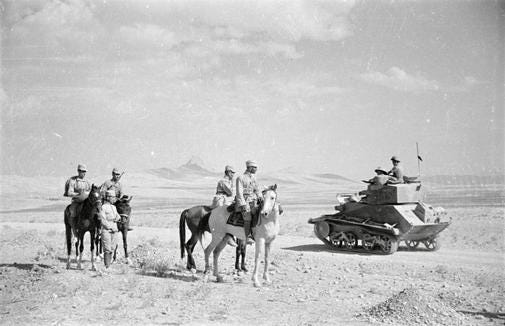
Photo: British and Soviet Soldiers linking up near Cazvin, Iran, 1941.
During the early years of World War II, Britain teamed up with the Soviet Union and invaded Iran to ensure that they did not remain neutral or support in some way the Axis side. After the British took direct control, dethroned the Iranian King Reza Shah on false charges, confiscated the royal treasury, and installed his son Mohammad Reza Pahlevi, as a puppet ruler.
London then requested the US begin to set up a logistical support operation in the Persian Corridor, eventually based in Iran, to supply Lend Lease to the Soviet Union. The request was made and FDR supplied troops BEFORE the US entered the war.
VIDEO: OPERATION COUNTANENCE 25 August to 17 September 1941. Joint UK / USSR invasion of Iran.
The joint Anglo British task force evolved into a massive production and shipping operation that fed tens of millions of tons of US equipment, food, and other services into the Soviet Union.
A CONNETICUT YANKEE GOES TO TEHRAN
“The accomplishments of the Persian Gulf Command cannot be overstated. Supporting the Soviet Union’s need for equipment and raw materials made for an interesting story of the Allies working together to achieve the common goal of defeating the Axis powers. The PGC delivered tanks, airplanes, vehicles, locomotives and rails, construction materials, entire military production assembly lines, food and clothing, aviation fuel, weapons, ammunition, oil, gasoline, chemicals, aluminum and steel, machine tools, field telephones, and telephone wire. The efforts of the soldiers in the PGC thwarted the attempts of Nazi Germany to defeat the Soviet Union, allowing the Red Army to turn the tide on the Eastern Front and eventually overwhelm the Wehrmacht “ - US Army Office of the Historian
The United States’ involvement in the Persian Corridor during World War II, as detailed in the U.S. Army historical publication The Persian Corridor and Aid to Russia by T.H. Vail Motter, represents a pivotal chapter in American military and logistical history, underscoring a long-standing U.S. engagement with Iran. Following the Anglo-Soviet invasion of Iran in August 1941, prompted by Reza Shah’s refusal to fully align with the Allies and expel German nationals, the U.S. entered the region to support the delivery of Lend-Lease supplies to the Soviet Union. The Persian Corridor, a supply route through Iran into Soviet Azerbaijan, became critical after the Arctic and Pacific routes proved unreliable due to German naval threats and logistical challenges. By 1942, the U.S. Army assumed control of this corridor, prioritizing it as one of the highest Allied objectives to ensure the Soviet Union remained a viable force against Nazi Germany, particularly during the critical period before the tide turned in the Allies’ favor. This early U.S. presence in Iran laid the groundwork for decades of complex American-Iranian relations.
The strategic importance of the Persian Corridor stemmed from its role as the only viable, all-weather route for delivering substantial aid to the USSR, which was essential for sustaining the Eastern Front, where the bulk of the German Army was engaged. The U.S. Army’s Persian Gulf Command (PGC), initially the Iran-Iraq Service Command, was established to manage this massive logistical effort. Under commanders like Colonel Don G. Shingler and later Brigadier General Donald H. Connolly, the PGC oversaw the development of Iranian ports, such as Khorramshahr and Bandar Shahpur, and the Trans-Iranian Railway, which were expanded to handle the influx of supplies.
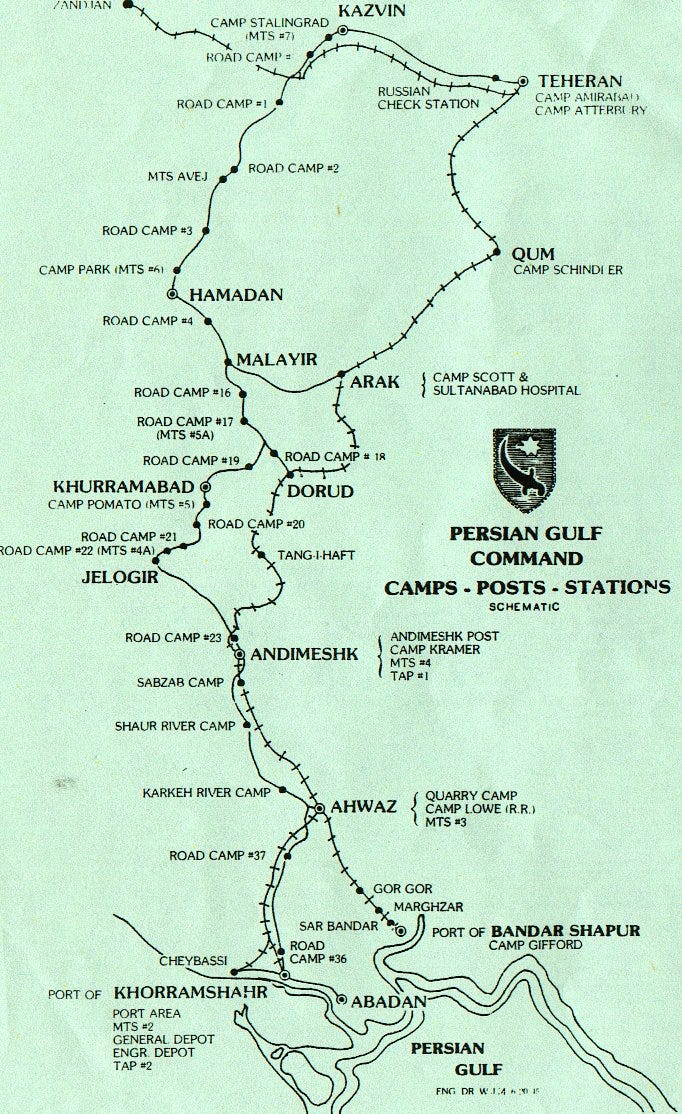
Photo: Map of US and British bases in Iran, Kuwait, and Iraq during WWII used to supply the Soviet Union.
By 1944, the corridor facilitated the delivery of over 5 million tons of materiel, including Studebaker trucks, P-40 fighters, and canned food, with 7.9 million of the 17.5 million long tons of U.S. Lend-Lease aid to the USSR (45%) transiting through Iran. This effort was instrumental in supporting Soviet victories, notably at Stalingrad, where supplies from the corridor, transported via the Volga River, bolstered the Red Army’s defense against the German offensive in 1942.
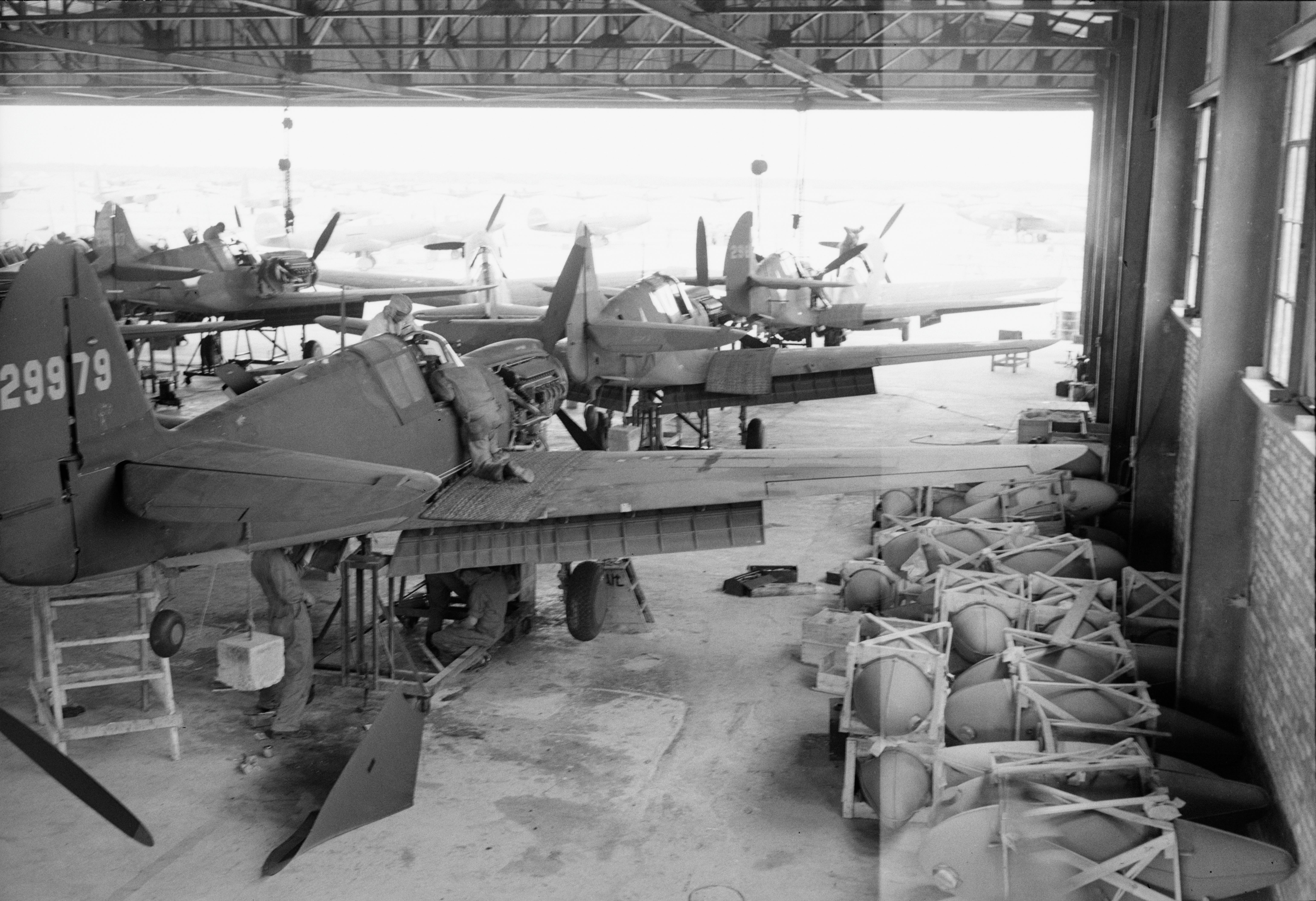
Photo: American P40 Aircraft being manufactured in the Persian Corridor (Iran) by American military and contractors to feed the Soviet Union and keep Stalin in World War II. The American and British logistical support for the USSR used Iran as a key transportation, communication, and production hub.
The U.S. Army’s operations in the Persian Corridor required significant infrastructure development and coordination in a challenging environment. The Iranian ports were initially ill-equipped, with Khorramshahr and Bandar Shahpur each having only one berth for large vessels, and the Trans-Iranian Railway was limited, carrying just 12,440 long tons of Soviet supplies in August 1942. The U.S. supplied ALCO diesel locomotives and 3,000 pieces of rolling stock to enhance rail capacity, while American engineers built or upgraded 1,000 miles of all-weather roads and operated assembly plants for aircraft and trucks. By July 1944, the PGC achieved a peak delivery of 282,097 long tons in a single month, overcoming bottlenecks like port congestion and inefficient inland clearance.
The presence of 30,000 U.S. troops, alongside British and Soviet forces, also accelerated social change in Iran, stirring nationalist sentiments that would shape post-war dynamics, as seen in incidents inspiring songs like Ey Iran.
The Persian Corridor’s success was not without diplomatic and operational tensions. The U.S. mission was tasked with prioritizing Soviet aid over British needs, creating friction with British authorities who retained strategic control of the region. The 1941 invasion had deposed Reza Shah, replacing him with his son Mohammad Reza Pahlavi, and the Allies’ occupation fueled Iranian resentment, exacerbated by food shortages and inflation. Despite these challenges, the U.S. commitment to the corridor was reaffirmed at the 1943 Tehran Conference, where President Roosevelt, alongside Churchill and Stalin, pledged economic assistance and respect for Iranian independence. The PGC’s efforts were lauded by Roosevelt during his visit to Camp Amirabad, where he praised the troops for their role in supplying the USSR, which historians estimate shortened the Eastern Front campaign by at least a year. The corridor’s closure after V-E Day in May 1945 marked the end of this intensive operation, but the U.S. presence left a lasting imprint on Iran’s infrastructure and its geopolitical trajectory.
The Persian Corridor operation highlights the United States’ critical role in sustaining the Allied war effort and its early entanglement in Iranian affairs, setting a precedent for future involvement. The corridor’s supplies were vital for the Soviet stand at Stalingrad, a turning point that prevented German forces from severing the Volga River route, which carried materiel from Iran to the Soviet heartland. The U.S. Army’s logistical prowess, demonstrated through the PGC’s management of complex supply chains, underscored America’s emerging global military influence. However, the occupation also sowed seeds of Iranian nationalism, as foreign troop presence and economic disruptions fueled anti-Western sentiment. This duality—strategic success paired with local discontent—foreshadows the complex U.S.-Iran relationship that would unfold in the Cold War, notably during the 1953 coup and beyond, making the Persian Corridor a foundational moment in this historical arc.
NOTES ON LEND LEASE AND THE PERSIAN CORRIDOR
The Lend-Lease Act of 1941 had a profound impact on World War II and U.S. foreign relations, with significant implications for the Persian Corridor and Iran, as detailed in the U.S. Army historical publication on the Persian Corridor. Below is a concise summary of its impact, emphasizing its role in supplying the Soviet Union via the Persian Corridor and its broader influence, particularly in the context of Iran and the war effort.
Strategic Lifeline for the Allies: The Lend-Lease Act enabled the United States to provide critical war materiel to Allied nations, particularly the Soviet Union, without direct involvement in the war before Pearl Harbor. It authorized the transfer of billions of dollars’ worth of supplies, including aircraft, tanks, trucks, and food, to nations whose defense was deemed vital to U.S. security. For the Soviet Union, facing the brunt of the German Army on the Eastern Front, Lend-Lease was a lifeline. The Persian Corridor, through which 45% of the 17.5 million long tons of U.S. Lend-Lease aid to the USSR (7.9 million tons) was delivered, became a cornerstone of this effort. Supplies like Studebaker trucks and P-40 fighters, shipped through Iranian ports and transported via the Trans-Iranian Railway, were critical in sustaining Soviet resistance, notably at Stalingrad in 1942, where materiel delivered via the Volga River helped turn the tide against the Nazis.
Strengthening the Soviet War Effort: The Lend-Lease supplies delivered through the Persian Corridor were instrumental in keeping the Soviet Union in the war. By 1944, the corridor facilitated the delivery of over 5 million tons of materiel, with peak monthly deliveries reaching 282,097 long tons in July 1944. These supplies bolstered Soviet industrial and military capacity, enabling victories that historians estimate shortened the Eastern Front campaign by at least a year. The corridor’s reliability, compared to the hazardous Arctic and Pacific routes, ensured consistent aid, which was vital during the critical 1941–1943 period when the USSR faced near collapse. This support not only preserved the Soviet war effort but also tied down German forces, easing pressure on Western fronts.
U.S. Involvement in Iran: The Lend-Lease Act catalyzed significant U.S. engagement in Iran, marking an early chapter in a complex bilateral relationship. To manage the Persian Corridor, the U.S. Army established the Persian Gulf Command (PGC), deploying 30,000 troops to Iran to upgrade ports like Khorramshahr, expand the Trans-Iranian Railway, and build 1,000 miles of roads. This infrastructure development, driven by Lend-Lease priorities, modernized parts of Iran but also stirred nationalist sentiments due to the Allied occupation following the 1941 Anglo-Soviet invasion. The U.S. presence, while focused on Soviet aid, laid the groundwork for post-war American influence in Iran, foreshadowing tensions seen in events like the 1953 coup.
Economic and Diplomatic Impact: The Lend-Lease Act transformed the U.S. into the “arsenal of democracy,” with $50.1 billion in aid (equivalent to over $700 billion today) distributed to allies, including $11.3 billion to the USSR. In Iran, the act’s implementation required delicate diplomacy, as the U.S. balanced Soviet demands, British strategic control, and Iranian sovereignty. The 1943 Tehran Conference reaffirmed U.S. commitment to Lend-Lease and Iranian independence, though occupation-related disruptions fueled local resentment. The act’s economic ripple effects included inflation and food shortages in Iran, which complicated Allied-Iranian relations.
Long-Term Legacy: The Lend-Lease Act’s success in the Persian Corridor highlighted U.S. logistical prowess and its emerging role as a global power. By enabling the Soviet Union to withstand Nazi aggression, it shaped the Allied victory and the post-war geopolitical landscape. However, the U.S. presence in Iran, driven by Lend-Lease, sowed seeds of anti-Western sentiment, influencing Iran’s nationalist movements and later U.S.-Iran relations. The act’s legacy thus includes both its critical wartime contributions and its role in setting the stage for complex international dynamics in the Middle East.
FINAL THOUGHTS:
The history of the “Persian Corridor” is not completely lost to history. The geostrategic importance is still recognized today, with an Iran that is bordered by two nuclear armed Shanghai Cooperative (SCO) partners and one anti US ally: Pakistan, Russia, and Afghanistan. The development by Beijing and Moscow of energy and trade routes using the same Persian Corridor as the British and Americans did in WWII, has a different purpose, but takes advantages of the same “ant tracks” that the US Army knew and developed almost a century ago. Note that the new Persian Corridor through Iran isolates and reduces the Suez Canal and Israel’s geographic importance in guarding it’s eastern flank.
More discussion on this in the Detective HQ (for Members and Coffee buyers).
Who has the time . People live charmed lives.
Detective headquarters?