The Silver Samurai
How Japan's Mining Boom Forged Warriors and Shoguns

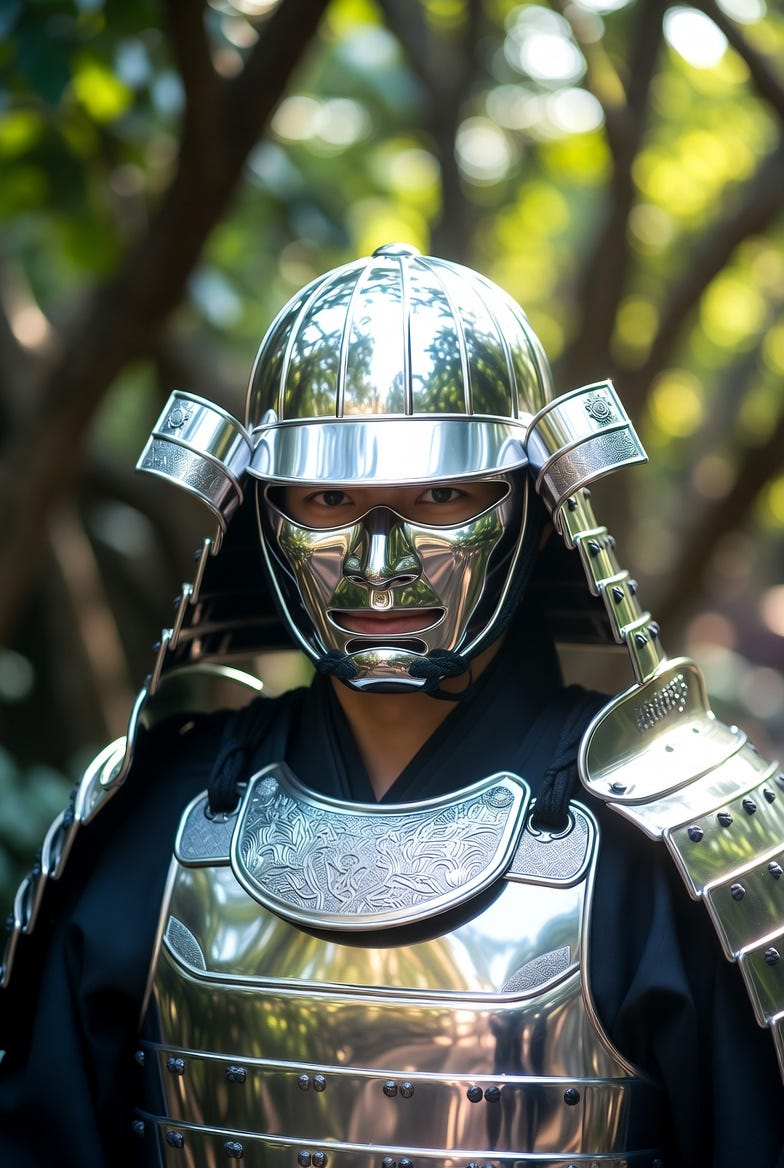
Image: Grok Ai Generated from authors Request.
This third installment in our silver series explores the hidden metallic thread running through Japan’s turbulent history and how managing this valuable resource was vital in determining the island nation’s history.
In previous installments, we looked at silver’s influence in the American West, especially the violence surrounding the OK Corral and payments to foreign entities ( “The Silver Heist”), as well as silver’s symbolic role in a US economic allegory and arguments over silver as a currency for farming and the working class (”The Silver Lining in The Wizard of Oz”).
To begin, we will shift our focus eastward to investigate how innovations in silver extraction transformed the chaos of feudal civil wars into centralized power. In tracing this transformation, we will highlight how silver functioned not only as currency but also as a metric for assessing the lifeblood of armies, alliances, and empires during the Sengoku Jidai (1467–1603) and the early Tokugawa era (1603–1868) in Japan.
In the mid-16th century, three key factors converged, setting the stage for Japan to become the world’s leading silver supplier and profoundly shaping the nation for centuries: (1) Innovations in mining technology enabled efficient, large-scale extraction of silver and gold; (2) The Portuguese and Dutch expanded into Asia, bringing advanced weaponry and seeking trade with the Ming Empire; (3) Japan entered a prolonged civil war among feudal lords, known as the Sengoku Jidai.
The Spark of Innovation: Technological Advances in Silver Mining
Japan had long mined silver, gold, copper, and other precious metals. The Japanese ability to use metal was highly advanced for the time, and the skill set was institutionalized and continually improved. However, the extraction of precious metals like silver still required methods that left the mines operating at low efficiency.
This changed in 1533, when techniques introduced in Hakata adopted a cupellation method known as haifuki, which used a gray-copper smelting technique to more effectively separate silver from the ore. It involved smelting silver ore with lead to form an alloy, then oxidizing the lead in a furnace to separate pure silver. This innovation caused a radical boost in efficiency, multiplying output and supercharging the development of better organizations around mining operations. Samples from at least four major silver mines, plus one lead-silver site, help demonstrate the volume and quality of extraction. Japan as a whole accounted for roughly one-third of global silver production in the late 16th–early 17th centuries.
Other innovations quickly followed, such as efficient drainage systems and labor organizations. Techniques included hand-dug tunnels (mabu), drainage systems, fire-setting for hard rock, and labor-intensive methods like the Onagashi placer gold extraction, in addition to the haifuki silver technique. Other techniques in use, such as sulfur and salt cementation, were traditional methods cross-levelled and taught by experts from other Japanese mines (Iwami, Ikuno, Kai). All these combined to develop the many silver and silver/gold mines into industrial hubs, which by the late 1500s made Japan the world’s top silver producer, exporting up to one-third of global supply.
Alongside a culture of innovation, Japan was also considered “blessed by the Kami” with numerous silver and silver/gold mines. Determining the exact number of these mines is challenging, given their range from small local operations to major industrial sites, incomplete records, and overlapping periods of activity. Nevertheless, historical sources suggest that dozens, possibly more than 100, silver or gold-silver mines were active at various times, especially during the 16th–17th centuries. Further evidence, such as European maps from the mid-16th century, shows many silver mines scattered across Japan, in addition to those above, reflecting both the widespread “silver rush” and the interest in the resource by foreign powers.
The most prominent and economically significant ones included:
Iwami Ginzan (Shimane Prefecture): Japan’s largest and most famous silver mine, discovered in 1526 and the primary driver of the “silver boom.” Peak production occurred in the late 16th to early/mid-17th centuries (roughly 1550s–1650s), when Japan exported massive quantities (e.g., Iwami Ginzan alone produced up to ~38 tons annually at peak, contributing to national output of ~200 tons/year).
Sado mines (Sado Island, Niigata Prefecture): Including the Aikawa Gold and Silver Mine, Tsurushi Silver Mine (discovered 1542), and Nishimikawa (primarily gold but with significant silver output).
Ikuno Silver Mine (Hyogo Prefecture): Active from the mid-16th century (around 1542).
Other notable ones include In-nai, Taniguchi, Nobesawa (a short-lived rich mine in the early–mid-17th century), and various sites in regions such as Noto, Suruga, Kai, and northeastern Japan.
Keep the location of the mines above in mind, as they become important during the long period of civil war that was soon to begin.
Silver’s Shadow on the Battlefield: Fueling the Sengoku Jidai
From the early Sengoku Jidai, control over silver mines was a critical factor in daimyo power dynamics. Many mining innovations such as haifuki around 1533 dramatically increased production, opening a surge in revenue that enabled many daimyo to increase their ability to wage battle and fund influence and clandestine operations.
Mines such as Iwami Ginzan, Sado, Ikuno, and the Koshu/Kai region were hotspots in the routes-and-resources battles that erupted among the daimyo vying for dominance over all Japan. Silver funded professional armies, imported firearms and gunpowder via Nanban (European) trade starting in 1543, and enabled trade with the Ming Empire for silk, porcelain, and raw materials—creating a “silver cycle” that sustained warfare but also drove economic monetization in parallel. This cycle would eventually help the transition to a stable and developing Tokugawa period.
Daimyo who controlled these resources could mint coins, pay troops in metal (replacing rice/barter), and expand territories, accelerating the path to unification under the three daimyo who eventually unified Japan : Oda Nobunaga, Toyotomi Hideyoshi, and Tokugawa Ieyasu.
However, other key daimyo prior to the the big three unifiers emergence had cleared various areas and set the strategic situation that allowed the big three to succeed later.
Of these enabling daimyo, Takeda Shingen and Uesugi Kenshin are famous not only for their rivalry but also for their ability to quickly recognize and exploit the extraction and flow of silver and gold, setting the building blocks for what came later.
Below is a short outline sequence focusing on the daimyo, detailing mine control, silver flow/trade, and how it aided dominance at key times. Much of the information was taken from icomon.mini.icom.museum at the time of writing and translation software utilized.
Takeda Shingen and Clan (Mid-1500s Peak)
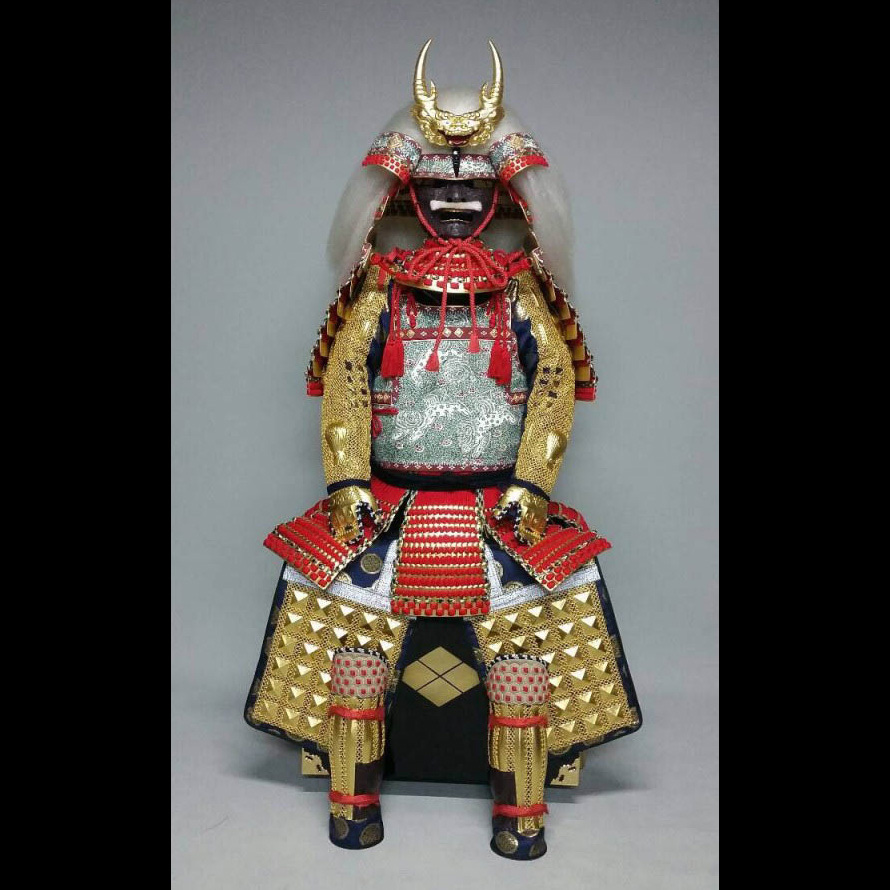
Photo: SamuraiMuseum.jp https://www.samuraimuseum.jp/shop/product/shingentakeda/
Takeda Shingen (1521–1573), daimyo of Kai province, leveraged control of the Koshu region’s gold and silver mines (Kurokawa gold mine) to build one of the era’s strongest forces.
These mines, part of a broader “mining frontier” expansion from the mid-16th century, enabled him to mint standardized “Koshu Kin” gold coins (in units such as ryo and bu), which circulated widely and funded military innovations, including road-building for logistics and siege tactics.
Silver and gold production here surged due to prospecting and labor organization, providing war funds and vassal rewards. This control was pivotal in gaining dominance: By the 1550s–1560s, Takeda’s wealth enabled a formidable cavalry army to expand into the Shinano and Suruga provinces. It directly fueled the prolonged rivalry with Uesugi Kenshin, culminating in the five Battles of Kawanakajima (1553–1564), in which both vied for the resource-rich borderlands.
Silver trade flows—exporting to China via intermediaries for gunpowder and silk—bolstered his economy, allowing imports of early firearms. However, over-reliance on mines made them targets; Shingen’s death in 1573 weakened the clan, as rivals like Oda Nobunaga began encroaching on central resources.
Uesugi Kenshin’s Dominance and Consolidation (1560s–1570s)
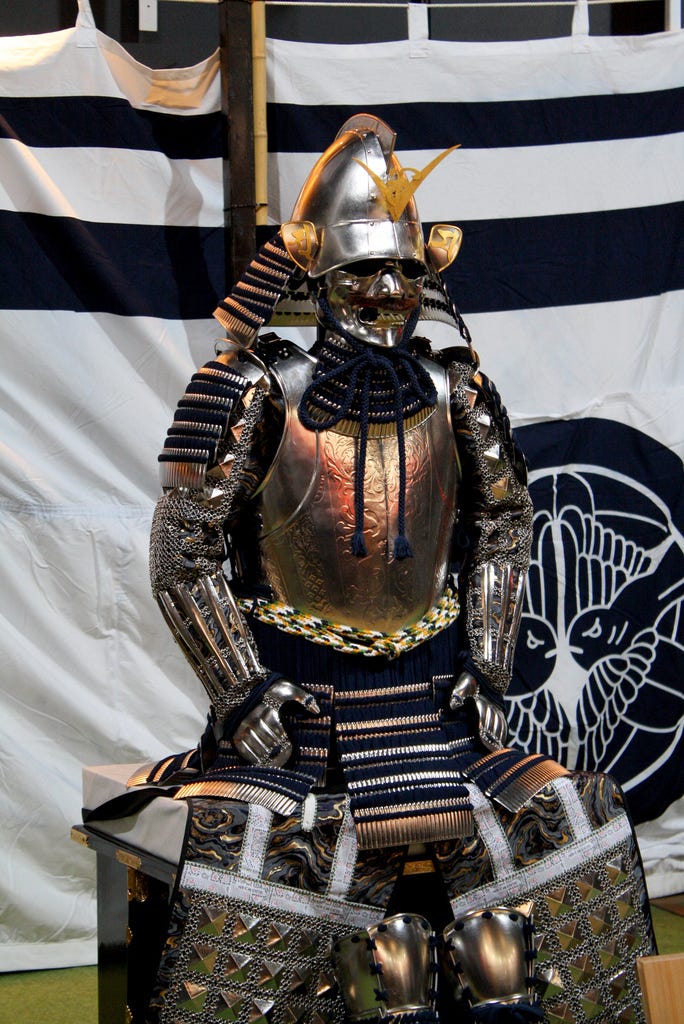
Photo: http://www.flickr.com/photos/27124035@N06/3956226576/ Tick
Uesugi Kenshin (1530–1578), daimyo of Echigo, controlled mines in the Jouetsu region (gold-silver deposits) and benefited from trade routes through northern Honshu.
While not as mine-rich as Takeda’s Kai, his territories included access to Sado Island mines (gold with silver byproducts), which he contested and partially influenced through alliances.
Kenshin’s military prowess, funded by silver revenues, allowed him to consolidate power in the north after Takeda’s setbacks. Silver-assisted dominance during the long Takeda conflict: Post-Kawanakajima stalemates, Kenshin’s forces dominated by the 1560s, using mine-derived wealth to hire mercenaries and import weapons.
He expanded into Etchu and Kaga, controlling trade flows of silver to China for essentials, which sustained prolonged campaigns. By the 1570s, as Takeda weakened, Kenshin consolidated northern domains, briefly allying against rising threats like Oda. However, his death in 1578 created a power vacuum, shifting momentum southward.
Oda Nobunaga (1570s–1582)
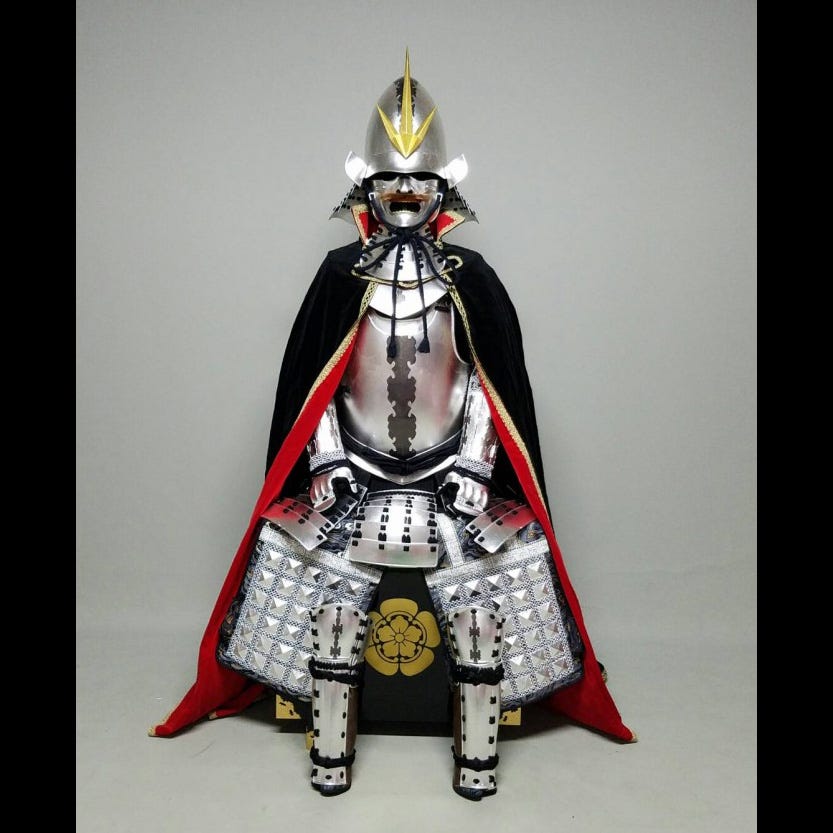
Photo: SamuraiMuseum.jp https://www.samuraimuseum.jp/shop/product/nobunagaoda-nanbando/
Oda Nobunaga (1534–1582) rose by seizing central Japan’s mines, transforming silver into a tool for rapid dominance. Starting in Owari, he prospected local deposits and, by the 1570s, captured major sites such as the Ikuno silver mine (1570) and parts of Iwami Ginzan through campaigns.
He enforced production increases, hired experts, and shifted to silver-based taxation (banning rice payments), thereby monetizing the economy.
This control fueled his unification push: Silver funded massive armies (paying in metal) and imported Portuguese arquebuses, enabling victories such as Nagashino (1575) against the remnants of the Takeda clan.
By 1580, Nobunaga controlled most major mines, exporting silver via Nagasaki for gunpowder and silk, creating a trade surplus that allowed him to finance, focus on, and equip for an advanced form of professionalized warfare.
This “gunpowder revolution” helped him dominate central Japan, but his assassination in 1582 halted full unification.
Toyotomi Hideyoshi (1582–1598)
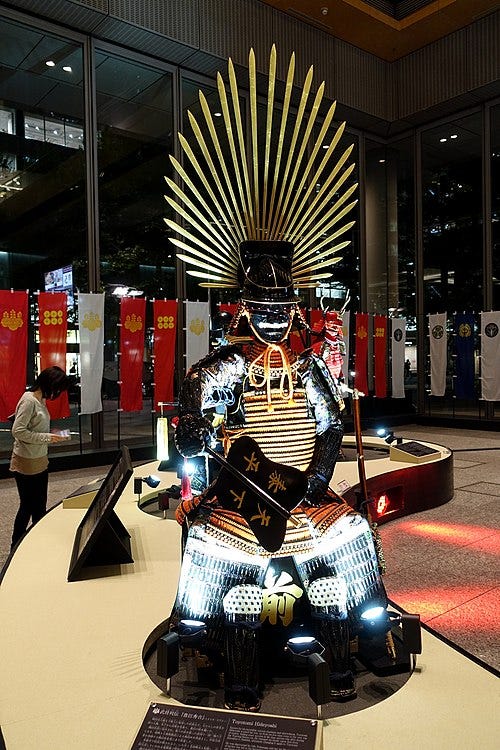
Photo: Toyotomi Hideyoshi armor (replica) - Siege of Osaka Quadricentennial, Yukimura Sanada and Sengoku Samurai Warriors - Marunouchi Building, Tokyo, Japan. Public Domain by Daderot.
Toyotomi Hideyoshi (1537–1598) succeeded Nobunaga and began centralizing control over mines, declaring all gold/silver mines “mountains of the state” and demanding 25–33% tribute from daimyo operators.
He standardized silver ingots, seized the Iwami Ginzan mine complex in its entirety, and developed domestic production while monopolizing the Nagasaki trade.
Silver flows were directed to central markets in Osaka and Kyoto, with overseas voyages restricted via permits.
The silver trade was critical to his power. Revenues funded the “Sword Hunt” (1588) to disarm peasants and massive campaigns, including the Korean invasions (1592–1598), to secure more trade routes.
By the 1590s, increased silver circulation expanded consumer markets, rewarding samurai with silver-backed bounties.
This allowed Hideyoshi to complete many of the organizational structures that solidified unification, focusing on central control by integrating formerly separate daimyo economies under central authority and thereby building a central power base.
However, the Hideyoshi clan’s hold on power was short-lived. Toyotomi died in 1598 at the age of 63. He left only one 5-year-old heir who was from a relationship with a concubine. Within two years, Ieyasu Tokugawa had seized power and would soon establish the legendary era.
Beating Swords into Silver Plowshares: Silver and the Rise of the Tokugawa Shogunate (*Yes there really was a “silver lining” to the decades of civil war).
Tokugawa Ieyasu and the Shogunate (Post-1600)
After the Battle of Sekigahara (1600), Tokugawa Ieyasu (1543–1616) captured the remaining mines, such as Sado and Iwami, placing them under direct bakufu (shogunate) control and raising tribute to 33–50%. However, he would reward faithful allies with mining rites, solidifying loyalty and increasing revenue to support his reign.
He seized diplomatic/trade powers from Hideyoshi’s heirs, exempting mining from the sakoku (1639 isolation policy) to allow continued foreign mining expertise to enter Japan.
These policies solidified Tokugawa’s dominance. The silver was used to fund the sankin-kotai system (daimyo alternating residence in Edo, draining their resources and anchoring them to the Tokugawa Shogunate) and to stabilize currency through a multi-metal system inherited from Sengoku-era practices.
Trade flows shifted as production peaked, then declined (post-1630s depletion), prompting export curbs and domestic substitution, such as cotton and later silkworms.
The Double-Edged Sword: Tokugawa Policies and Silver’s Decline
By the early 1600s, this “cooling off” of the silver boom helped finalize the lingering Sengoku chaos, helping the Tokugawa clan to establish a remarkable 250 years of peace and internal development while keeping the foreign influence at bay.
In summary, the increase in silver mine production was critical in funding and promoting a transition of silver from being a regional power booster (Takeda/Uesugi rivalries) to a central, whole-of-state unification tool (Oda/Hideyoshi/Tokugawa). The silver trade outflows to the Ming Empire/Europe also funded the shift from Japan’s feudal anarchy to a stable shogunate that lasted almost 3 centuries. So while silver depletion by the mid-1600s forced policy adaptations, the initial silver boom and wise policy decisions by key daimyo were decisive in reshaping, stabilizing, and developing Japan.
Japanese silver mines did not deplete uniformly—production shifted over time, with many continuing on a reduced scale into the modern era—but the major boom ended due to resource exhaustion, technological limits, flooding, and competition from New World mines, including Potosí in Bolivia, that eventually replaced Japan as the largest silver supplier for the global market. Decline became noticeable in the late 17th century (from the 1660s–1690s onward), as easily accessible high-grade ores were exhausted. By the mid-to-late 18th century (1760s onward), many mines were “approaching exhaustion” or “bled dry,” prompting the Tokugawa shogunate to curb silver exports, shift to copper, and eventually import silver/gold. Iwami Ginzan production fell sharply in the 19th century due to global competition and depletion; it continued limited operations until closure in 1923.
The Sado mines’ production declined from the mid-Edo period (post-early 17th-century peak) due to issues such as water ingress. Modernization in the Meiji era (from 1869) temporarily revived output, but it tapered out by the mid-20th century, with full closure in the last year of the Showa period, in 1989.
Overall, by the late 18th century, Japan’s silver era had largely ended, with mines facing depletion, lower grades, and profitability issues. Some persisted into the 20th century on a smaller scale or with imported technology, but the pre-modern “silver wealth” that fueled Sengoku wars and early Tokugawa policies was gone by the 1700s–early 1800s.
This depletion influenced Tokugawa policies, such as sakoku (isolation) to stem the flow of silver overseas, currency debasement, and a shift toward domestic substitution and copper exports.
THE “CHINA CONNECTION” AUTHOR’S NOTE:
This paper uses the term “Ming Empire” rather than “China” or “Ming Dynasty” to accurately reflect and adhere to a common standard for distinguishing empire from dynasty. “China” did not exist until 1911 as an imagined revival of Han dominance in the continent’s “Middle Kingdom” area. As such, where other authors have a dual system for the West and China in historical definitions, we will use the same standard for both.
The Ming Empire and many of the other kingdoms that came before it on the continent originally produced their own silver, and at various points, the region was the largest exporter of silver until the Ming Empire, when paper currency replaced silver. As a result, the Ming Empire did not have enough silver to meet this demand.
Initially, most of the silver trade between the Japanese islands and the Ming Empire was conducted by Wako pirates and Ryukyu traders, but the growing war between the Ming and the pirates created a market niche for Europeans, especially the Portuguese and Dutch. The war effectively banned direct trade between Chinese and Japanese traders, so Portuguese middlemen could buy silk in China, sell it for silver in Japan, and then buy even more silk in China with the profits. This circle could be done as many times as required before the ship then sailed first to Goa and then on to Europe. A captain could begin this enterprise with 20,000 cruzados in Goa and expect to make 700% the profit on his return.
At its peak, the Portuguese silver trade accounted for more than half of the Dutch VOC’s total asset base each year. As we saw earlier with the “Silver Heist” article detailing the OK Corral’s violence and the connection to silver flows to Britain from the US, the silver was key as it was necessary for the British to pay the Manchu Empire (who had conquered the continent and overthrown the Ming Empire) for tea and other goods demanded of Britain’s subjects as well as keep funding the Indian Rupee, which unlike the British Pound, was backed by silver.
So we can see that, centuries apart, a common dynamic was at work. A third country, rising to the top of global silver production, was needed by a maritime trading power to exchange goods for those of the dominant empire on the Asian continent. Today, that major empire is China.
Sources and Notes:
Brian D. Colwell. “A History of Gold and Silver in the Early-Modern Era.” Brian D. Colwell (blog), https://briandcolwell.com/. (Accessed January 10, 2026).
“Iwami Ginzan Silver Mine and Its Cultural Landscape.” Nomination dossier for UNESCO World Heritage List, 2007. https://whc.unesco.org/en/list/855/documents/. (Accessed January 11, 2026).
Japan-Insights. “Cipangu, Land of Gold and Silver.” Japan-Insights (website), https://www.japan-insights.jp/pdf/essays/JIN_LandOfGoldAndSilver_01.pdf. (Accessed January 11, 2026).
Okubo, Takashi. “Mining Frontiers and Their Impact on Money.” Paper presented at ICOMON (International Committee for Money and Banking Museums). https://icomon.mini.icom.museum/wp-content/uploads/sites/20/2018/12/Mining_frontiers_and_their_impact_on_money__from_the_viewpoint_of_Japanese_monetary_history.pdf (Accessed January 11, 2026).
Samurai Archives. “Silver.” Samurai Archives Wiki. https://samurai-archives.com/wiki/Silver. (Accessed January 10, 2026).
Takeda, Toshiaki. “Japanese Economic Growth during the Edo Period.” CMMC-Nice https://cmmc-nice.fr/wp-content/uploads/2014/02/prof_TAKEDA-Japanese-Economic-Growth-during-the-Edo-Period.pdf. (Accessed January 10, 2026).
Tetsuya Nakanishi, and Eiji Izawa, “Evolution of Silver-smelting Technology of Japan in the Middle of Sixteenth Century”, ISIJ International, 2014, Volume 54, Issue 5, Pages 1093-1097, Released on J-STAGE June 12, 2014, Online ISSN 1347-5460, Print ISSN 0915-1559, https://doi.org/10.2355/isijinternational.54.1093, https://www.jstage.jst.go.jp/article/isijinternational/54/5/54_1093/_article/-char/en (Accessed January 15, 2026)
Enjoyed learning more about the Dutch VOC and how it had a monopoly on Asian trade for several years…and how the Portuguese learned how to buy silk from China and sell it to Japan for silver…doing this repeatedly on same trip…made huge profits. The shift to Potasi Mine in Bolivia as largest silver supplier for the global market as Japan’s market became exhausted….Japan became more isolationist to stem the flow overseas of the remaining silver. Enjoyed learning how the feudal anarchy of the daimyo shifted to a stable shogunate for 3 centuries of peace and stability and growth due to the funding by silver…and wise policy. Silver aided hugely Japan’s unification. Shogunates…military dictatorships….required large tributes from the feudal lords which helped end their power. This history is new to me. Had no idea the silver power running though Japan for centuries. Silver made development and growth possible for Japan…ample funds to invest. Thank you. Valuable history to know. Learned China did not exist until 1911. Much more to learn. Wonderful. As Rose commented: intellectual manna from heaven.
This historical account was intellectual manna from heaven. Thank you! 🌹👵🏻🐦⬛🔍